Ghost Stories: bibliotherapy, grief, and learning to survive
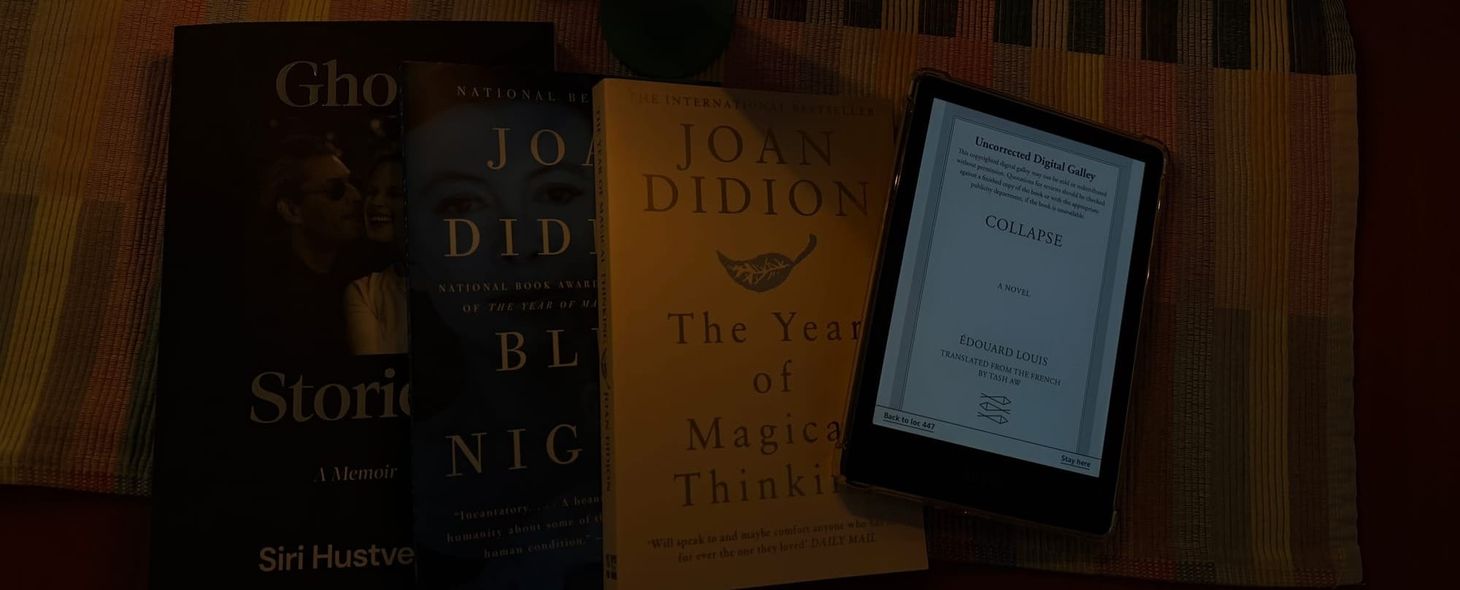
Death is the last great literary taboo. On a sunny day or a fire-lit night, a book that reminds you that you, or the ones you love, could vanish at any moment is not the natural choice. Only once the loss occurs do people grasp for someone else’s story; for proof that life can and will go on. If they don’t go searching themselves, it may be thrust upon them by well-meaning loved ones. I recall a video where a young widow stacked every copy of The Year of Magical Thinking she received after her husband's death until the pile covered the camera.
In this and so many other ways, I am not the typical reader. I have been obsessed with morbid books and devastating life stories for as long as I can remember. I have a complicated relationship with luck, but I consider this one of the times it worked in my favour. Years of preparatory reading left me uniquely qualified to handle my own brushes with death. Having read so broadly on the topic there was nothing truly unknown to me. Without tempting fate, as a voracious reader, there is almost nothing that can happen that I would have zero frame of reference for. The power of memoir in most cases is that no matter how harrowing the story is, the survival of the writer is guaranteed by its existence. Even when it isn’t, there is still a path forward. When Breath Becomes Air by Paul Kalanithi is one such story with no happy, miraculous ending but plenty of proof of resilience, love, and a life well lived. Finished by Paul’s widow after his death the wildly successful book provides a rare glimpse into terminal illness as an end-to-end process, with the perspective of both the patient and their closest family. As I was preparing to send this newsletter, I encountered a similar testimonial about a terminal cancer battle from Richard Scoyler, published after his death.
There is a natural narcissism to grief. The entire universe becomes secondary to the vacuum left in the wake of a loss, a void threatening to drag everything down into it. It changes the way we experience time, sound, temperature, and everything that went before it. Most confusing is the fluidity – how it is impossible to predict or prepare for how it will affect you from one moment to the next. Some people fall apart immediately while others function somewhat normally for hours or days, only to be taken out at the knees by the realisation hitting all at once seemingly without prompting. This volatility is impossible to prepare for or understand unless you hear about it from someone that has already survived it. This is a difficult balance to strike in a conversation. No one having the worst day of their lives feels ready to hear about someone else’s, but the unique relationship we have with literature makes reading about it more tolerable.
‘I’ve immersed myself in bereavement studies. When troubled, I read. I read obsessively about whatever is troubling me. It doesn’t solve the problem. It brings me distance. It chills the burn. It’s preferrable to a bottle of scotch’ – Siri Hustvedt, Ghost Stories
Someone asked how long it had taken me to finish Ghost Stories, Siri Hustvedt’s latest work about her marriage after her husband’s death from cancer. They were also reading it but found themselves putting it down to take breaks. I did the same thing, ultimately finishing four other books in the weeks between starting and finishing it. The fragmentary format of the book propels you forward, but the content repels you. As soon as you feel like you have escaped the worst of it, the torturous descriptions of what it feels like to lose your soulmate, you’re interrupted by a letter from the deceased himself, addressed to his infant grandson whom he knew he would not see grow up. This makes it one of the best representations of grief; just when you think you have fought your way to the surface something drags you back under. The mention of a new milestone that will be missed, or a side of Paul that the world has lost now.
When I finally finished Ghost Stories, I felt capable of reading another morbid book on my TBR – figuring that it could not possibly be as sad. Collapse by Édouard Louis is the “fictionalised” story of his estranged brother’s death and a post-mortem of their relationship. It is not the typical memoir of grief. Louis is clear throughout, and has highlighted in interviews, that he hated his brother. The book is an unflinching look at the complexities of grief within families and a rejection of the human impulse to wipe the slates of the dead clean. Still, there are anecdotes that clearly show some fraternal affection. No person is all good, or all bad, and no one has a single, pure feeling about losing someone. Louis examines each of his feelings about his brother and tests them against different theories gathered from a lifetime of reading and writing, as Hustvedt did, to very different ends.
‘On the train I’d brought a stack of books on the theme of death that I’d clumsily shoved into my backpack in the hope of grasping what was happening to me, or rather, what had just happened. I placed the bag at my feet and took out Joan Didion’s memoir, The Year of Magical Thinking. As I leafed through it, the book fell open at a page I’d dog-eared when I first read it, a few years earlier, where Didion, herself reading Philippe Ariès and his studies of the Middle Ages, reflects upon the signs that a dying person is able to perceive before anyone else.’ – Édouard Louis, Collapse
Louis read Didion. Didion read Ariès. Hustvedt read C. S Lewis (A Grief Observed), Dickinson, lectures from William James, and medical journals on types of hallucinations. Each of these people lost someone and went looking for answers from someone else who had already done so.
Later, while re-reading The Year of Magical Thinking, Louis realises the way his mother immediately started to plan her son’s funeral is not, as he naively thought, a sign that she is coping well with the loss. As mentioned by Didion, recounting her own experience, this immersion in the administration of death was a crude postponement of grief by distraction.
Proof that you benefit most from doing the reading before the lesson life serves you directly lies in Louis’ choice of Didion’s memoirs. While The Year of Magical Thinking is the one he had to hand in the early hours of the morning after his brother died, the more apt Didion text would have been Blue Nights. The parallels between the two decedents are plentiful. Louis’ brother dies at 38. Quintana, Didion’s daughter, dies at 39. Both, according to the books about their deaths, experienced a brain haemorrhage they initially survived. Louis admits his brother was an alcoholic. Didion skirts the issue, admitting excessive drinking but failing to call the spade that will eventually (allegedly) kill her daughter a spade.
The experience Louis is witnessing is not of a wife losing her husband as they sat down to dinner, but of a mother losing her child after a prolonged struggle with mental and physical illness. In Blue Nights, Didion questions how well she performed in her role as adoptive mother. In Collapse, Louis repeatedly questions what he owed his brother, and whether he had the right to forsake it. Both subjects are described as having fatal abandonment wounds: Louis’ brother from his father’s estrangement, Quintana from being adopted.
Without addressing it by name, Collapse resembles Blue Nights in its self-interrogation, repetitions, reliance on “facts” and testimonies from others as if building court submissions. It is possible, even likely, that he is unaware of these similarities or that they are pure coincidence. As Hustvedt comments in Ghost Stories, when struggling to recall if a theory was coined by her or her late husband, authors find inspiration everywhere and are often unaware of it. The biggest difference between the two books is not the language they were written in, the age of their authors, or the nature of the relationship to the decedent. It’s how they handle class. Where Didion famously name drops, Louis provides vignettes into a childhood and life path marred by poverty. He wonders if his brothers outsized dreams sealed his fate, or if the dreams were so large in a maladaptive attempt to escape it.
‘In our world we couldn’t allow ourselves to try, while in other worlds mistakes are possible, and I tell myself – it’s just a hypothesis, it’s too late now’ – Édouard Louis, Collapse
Quintana had opportunities Louis’ brother could not have dreamed of, and they were both still dead by 40. The number of mistakes one can make and come back from are not evenly or predictably distributed. Regardless, it’s too late now.
Being well read – in the genuine sense, not the online one – provides an underappreciated superpower. It lends you language where your own might fail. In moments of acute crisis, where you are overwhelmed by intense or discordant feelings, it feels miraculous to have a quote you can point to where someone has expressed it for you. To say “as I sat outside the funeral parlour, I knew I would write a book about my brother” sounds deranged. But to explain it as Louis does in Collapse, by referencing Jamaica Kincaid having the same realisation upon learning of her brother’s imminent death, is to participate in the continuation of a ritual. While I was in hospital myself, reacting with remarkable neutrality to the news I had a potentially fatal condition after surviving a different one, I told a curious nurse that it all came down to the Eve Babitz quote – ‘It’s only temporary: you either die or get better.’
I had first come across the phrase the year before while reading a collection that was not about illness or death. I had neither on my mind at the time I read it, but some part of me registered the line as one I should carry with me – tucked away in the part of my brain where I’ve been storing these titbits my whole life. Like Hustvedt, Louis, and Didion, reading didn’t solve my problem. But it did place it in context. It provided me reassurance that none of my suffering was unique, no matter how exceptional the circumstances felt at the time. At its core life is a process lived with bodies that fail and our main job is to enjoy it while we can. Counterintuitively, one of the best reminders for that is to read about the parts that make it hard to. In a world that tries to sell you a version of your loved one you can continue speaking to forever, or a simulacrum of someone to love your monthly subscription insures you against losing, a prescription to read morbid memoir is more essential than ever.
Further reading and how it might help:
- Found, Wanting by Natasha Sholl: I can’t think of a better example for what people can survive than this. It opens with Natasha describing the night her 27-year-old partner suddenly died. Throughout the book, that grief and new loss dovetail repeatedly. Her resilience is awe-inspiring.
- The Hero of this Book by Elizabeth McCracken: our relationship with our parents is fraught and may be semi-fictional, this autofiction title proves it. McCracken also has a memoir about her experience of stillbirth, An Exact Replica of a Figment of My Imagination, but I have not read it yet.
- Just Friends by Gyan Yankovich is wonderful and includes a discussion on grief.
- Sorrow and Bliss by Meg Mason is not a memoir but it is about surviving things you didn’t think you could, and while I was ill the quote “for want of another, beauty is a reason to live” was a mantra.
- Deborah Levy’s living autobiography series, more specifically The Cost of Living and Real Estate, are about surviving when life doesn’t follow your plans.
Note: there are two (free!) tickets left for Offline Book Club on 24 June, discussing Fruit Fly by Josh Silver.

make obsolete after reading Newsletter
Join the newsletter to receive the latest updates in your inbox.