On keeping a notebook (for 20+ years) and reading other people's
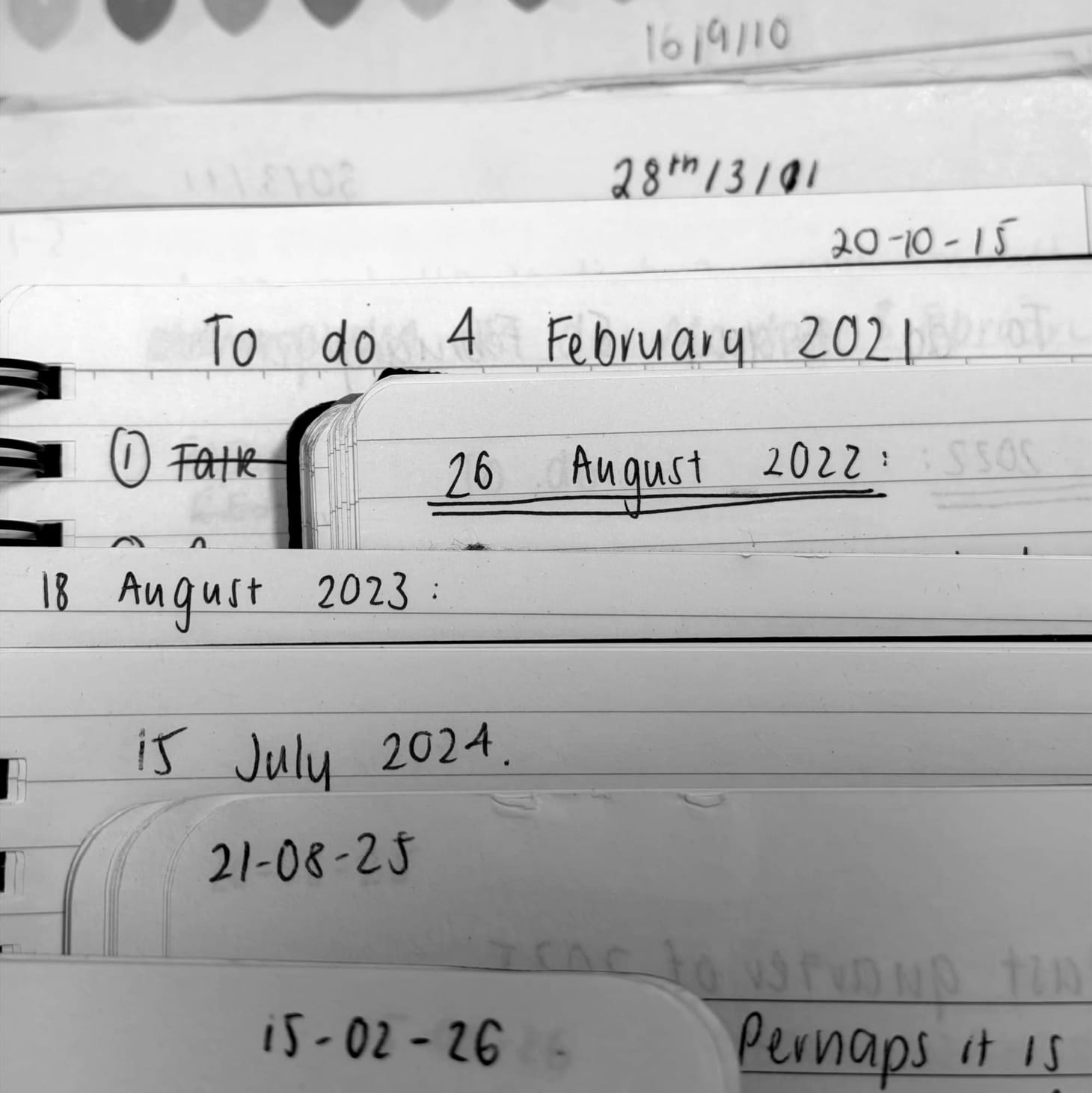
I have kept journals for most of my life. Starting with one of these bad boys (still the safest way to keep a secret, once locked you’re never getting back into it) and evolving through a series of notebooks before landing on my current preference: a red Moleskin softcover. I worry about the opsec implications of admitting this, but I still have most of them. They are a mix of painstakingly recorded whole days, fragments of conversations, and lists ranging from the quotidian to the existential. Basically, since I was aware I had an inner monologue, I’ve been writing it down for everything from first dates to what it felt like while I thought I was going to die.

There is something about the clarity of capturing your thoughts about a moment while it is still happening that shocks you when you revisit it. Over time, the memory of something can smooth over. As the protagonists of our own stories, we can selectively recall things in passive voice; every bad thing happened to us, and every good thing is a feat we achieved. A contemporaneous record challenges this. I often find when reading my journals that a misfortune could have been avoided if I listened to my own intuition. While I would prefer to believe I am a sensible person that has done the best I could with the information I had available, consulting what I wrote at the time may show that I knew or at least suspected more than I chose to rely on.
For as long as I have been writing journals I’ve been obsessed with those kept by others. The TV shows I enjoyed most as a child had features of a girl’s diary or a dramatized inner monologue (Lizzie McGuire, Unfabulous). As a teenager I read Sylvia Plath’s and Kurt Cobain’s journals (less laughs per minute than Lizzie McGuire). I felt a pull to understand precisely what was going on in other people’s heads that they weren’t saying out loud. The classic adolescent urge to see if anyone’s inner life was as complex as my own felt.
As I’ve continued to seek out journals from writers I admire, one of the great comforts has been seeing that being preoccupied by minor inconveniences, social missteps, or other trivial things were not disqualifiers for achieving great things. Contrary to what I was told as an insecure teenager, it seems no one fully grows out of the panic of what to wear to a fancy event.
I recently started reading Helen Garner’s journals. First published in 2019 and recently released as a complete volume, they span from 1978 to 1998. The first volume, Yellow Notebook, commences right after her first novel, Monkey Grip, was published. In it she details her experience as a newly published author trying to continue to write alongside her struggling marriage and ultimate divorce, daily life as a mother, and international adventures. What makes it unique is the lack of an intentional narrative. Rather than including whole entries it is presented in standalone undated fragments, possibly cut from a larger entry or drafted in isolation, allowing small slivers of insight that cohere into a richer picture only as you continue reading and thread them together yourself.
The experience of reading the moments absent their context - which you have little ability to infer - make it a dual experience of imagining someone else’s life and reflecting on your own. Each sensation Garner artfully describes may be savoured as a well-constructed impression or serve as a flashback to your experience of it.
Alphabetical Diaries by Sheila Heti similarly narrows the aperture to single moments, impressions, and thoughts. This time, they are not in chronological order. Heti put a decade’s worth of journal entries into a spreadsheet, sorted them alphabetically, then edited them down to one book. The effect is dizzying. Through the alphabetisation similar themes are grouped together and you see how Heti’s opinion of a single person or concept changes. Untethered from chronology you observe her oscillate from love to hate to indifference without knowing why, though you can tie a loose story together from your impressions by the end of the book.
In both Garner and Heti’s journals are lines about feelings or thoughts that resonated almost exactly with my own. Moments like this thrill me, to learn simultaneously that these are shared experiences and also to now have better language to explain them myself.
“My courage has been circumstantial” – Sheila Heti
“The whole time, the whole of my twenties, I had the sense that I was doing the wrong thing but I couldn’t have told you what the right thing was, except that possibly it was the opposite of whatever I was doing” – Sheila Heti
“Sometimes I look out at this richness of sky – layer after layer of colour rising from a bed of dove-grey cloud – and I think, This is a rich person’s view, or an adult’s view. As if I were not entitled to it, or had only temporarily, or on sufferance” – Helen Garner
While reading other people’s journals lets me understand them, as Joan Didion put more eloquently, reading my own keeps me in touch with myself from every age. While reading what 20-year-old me thought was important makes me wince it also shows me that whatever I am convinced is a life ruining development today will probably slip my mind in another month, year, or decade. There are (many) entries about how I will never get over something but through my failure to date them or include names I now honestly can’t tell you what or who they were about.
“...I think we are well-advised to keep on nodding terms with the people we used to be, whether we find them attractive company or not. Otherwise they turn up unannounced and surprise us, come hammering on the mind's door at 4 a.m. of a bad night and demand to know who deserted them, who betrayed them, who is going to make amends. We forget all too soon the things we thought we could never forget. We forget the loves and the betrayals alike, forget what we whispered and what we screamed, forget who we were.”
― Joan Didion, On Keeping a Notebook
I wrote in the last post that I disagree with the sentiment that reading is a medium where you’re prevented from contributing an opinion to a conversation. I do think this applies to journaling and is one of the main benefits. You have the space to figure out what you feel about something without trying to convince anyone else. You may, as I often do, discover through trying on different perspectives that a new one seems more realistic or start to see the flaws in the old ones. If you could CTRL + F my journals you would find dozens of instances where I follow paragraphs of seemingly definitive statements with “I’m not sure I really believe that”. My journal is where I first feel comfortable questioning myself. I have found that what I think I believe may be the result of pure repetition. When I interrogate why I think something and whether it is supported by the further information I’ve gathered since I first learned of it, I have the opportunity to change my mind.
This applies equally to external phenomena and the stories we tell ourselves about our pasts. With deeper consideration you can switch from obsessing over why something happened, or why someone acted the way they did, and start figuring out how you feel about it and why. The process of doing this with your own feelings can give you deeper empathy for the fact most other people probably don’t know precisely why they’ve done something and are unlikely to be able to provide the edification you crave unless they’ve undertaken a similar process.
When I write without the expectation of being read there is no pressure to be insightful, funny, or to make a coherent argument. Old stories and minor injustices are fair game for as long as I can withstand getting bored of them (a great sign that other people passed that point a while ago). Connections can be attempted and abandoned when they don’t quite fit – more than once, I have realised while writing that I am trying to make things reinforce one another that are not truly related. In turn, I find the conversations I have on topics I have journalled about are more productive, deeper, more interesting. Taking a topic I’ve been mulling over to a friend can make for a far better conversation than a typical play-by-play catch up.
Knowing I have committed to write something every day makes me pay better attention to what is going on around me. Sometimes I have a plan of what to write about, a small stone of a thought I have been turning over for days, other times I am inspired in the moment to pick up and write in response to something I’ve read, heard, or thought about. Like Helen Garner, some days I just describe the weather and how it feels to experience it. This can evolve into a resurfaced memory of a similar temperature or place or may exist as a standalone time capsule. Noticing things in preparation to record them tunes my attention to things I may have overlooked. A specific shade of the sky, the texture of materials in a waiting room, or the demeanour of a stranger I sit across from. I have never been much of day dreamer. Instead, I find myself ruminating on things that may or may not be productive. With the goal of writing every day journalling is a way to turn some of that attention outwards, to gather new material, and hopefully, fresh perspective.
If you want to start journalling, these are my beginner tips:
- read someone else's: below is a list of the journals I recommend.
- just write something: people often think you're meant to have an epiphany, then start writing. This is rare and especially unlikely if its never happened before. Sit down with a notebook and start by recounting the outline of your day. As you write, try to focus in on any details you can recall that seem interesting, annoyances you had, or funny things you encountered.
- let yourself get sidetracked: if you try the above and find you're overwhelmed by how much you would rather be on your phone, write about that instead. This isn't an essay assignment. If you follow that train of thinking you may uncover the real reason you feel that way or identify how remaining distracted is serving you.
- find better source material: if the idea of writing about your own day feels mind numbing try writing in response to something you have read, watched, or heard. Media consumption can be as passive or active as you make it. If you start writing about how certain media makes you feel you may learn new things about yourself or discover other avenues to explore. E.g. If your opinion is that all movies or tv shows or popular books at the moment are "the same" try identifying what about them feels similar. This can help you identify what to avoid with your next pick. When I'm uninspired, I like taking my journal to an art gallery and writing about what the art brings up for me, but I understand this requires a larger than average resistance to social anxiety.
Recommended reading:
- Slouching Towards Bethlehem - Joan Didion
- How to End a Story – Helen Garner
- Alphabetical Diaries – Sheila Heti
- Unabridged Journals of Sylvia Plath
- Theft by Finding – David Sedaris (if you’re looking for someone who notices everything David is your man)
- A Writer’s Diary by Virginia Woolf
%20and%20reading%20other%20people's)
make obsolete after reading Newsletter
Join the newsletter to receive the latest updates in your inbox.