Eternal Surprise of the Careless Mind
Memory is a funny, fickle thing. In tech right now, it is especially so. Not only because the cost of the physical hardware to store it has skyrocketed in recent years due to AI driven demand. The more abstract kind has also been put to the test in the trial between Elon Musk and Sam Altman over control of OpenAI. It was apt for a dispute about straying from your idealistic beginnings to be thrown out on timing grounds. Put simply, Elon had waited too long to raise the problem. The same trick he has used so often in his own companies was proven, by a court, to work. If the promises you made were long enough ago, most people will forget them and you will face zero consequences – no matter how clearly misleading they are later proven to have been, or how many times you do it.
We live in a world where every individual can be haunted by their own online posts – even if they were made in childhood. Yet there are now countless written records, in published books and court transcripts, of what goes on inside the tech companies that host our digital skeletons and the public consciousness still seems to be wiped clean each time a “new” scandal drops.
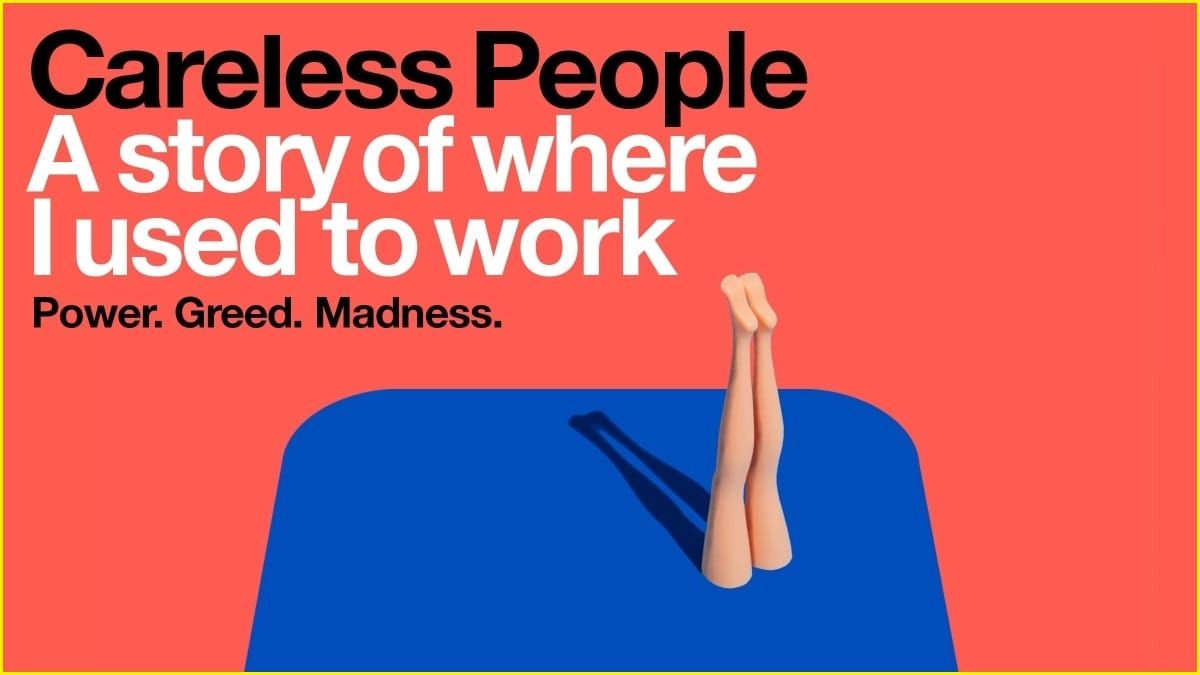
Recently, I finally read Careless People by Sarah Wynn-Williams. You may know it as the memoir Facebook tried to shut down, or the one where the author often sits silently on literary festival stages, barred from even nodding in response to questions from threat of $50,000 fines. On paper, I’m the ideal audience for Careless People. Yet, something put me off it. At first, it was pure apathy. I’d read too many tech books and was giving myself a break. Later, as I saw reviews and excerpts, it was a discomfort with the surprise everyone was showing for incidents that had been reported years earlier as if they were hearing of them for the first time (though, granted, the Sandberg stories were quite shocking).
After reading it, I was right to be sceptical. Much has been said of Facebook’s own goal in their handling of the memoir and their inability to heed the warnings of the Streisand effect. More than a year on from its release they are still actively blocking Wynn-Williams from speaking and selling hundreds of copies of her book each time they do. The story is of the book Facebook tried to ban, and the “bravery” of the author who wrote it anyway, rather than being about what the author herself is responsible for and whether her own telling of it is worth reading.
Careless People wasn’t the first Facebook memoir, nor the first by a woman about her experience at the company. The Boy Kings by Katherine Losse was published in 2012, just one year after Wynn-Williams had started at Facebook and before she had really managed to sell them on her vision of Facebook as a political power player. It focuses on the five-year tenure of Losse, who joined Facebook in September 2005 as their 51st employee (and the second woman). Originally tasked with answering user support emails, by the time she left in 2010, her role had evolved into ghost-writing for Mark Zuckerberg and assisting the company’s international expansion. She was, in this capacity, the predecessor to Wynn-Williams.
Unsatisfied with her role as customer support and unofficial hacker-wrangler, and her $20 an hour pay check, Losse started an unendorsed mission to expand Facebook networks by gathering the metadata for international universities. She also assisted with the translation of Facebook's interface into several languages. The same type of translation that, it was acknowledged in Careless People, was not done in several markets and contributed to Facebook being used there, effectively without any ability for Facebook to intervene, in furtherance of genocide. This level of crossover is why it strains credulity for me to believe Wynn-Williams has never heard of Losse or her book. Yet her story, her insights into Zuckerberg’s leadership, and her book, are never mentioned – in Careless People, or in any of the coverage of it.
The portrayal of Facebook most people are familiar with is the film The Social Network. Most people aren’t aware that the film was loosely based on a 2009 book, The Accidental Billionaires: The Founding of Facebook: A Tale of Sex, Money, Genius and Betrayal by Ben Mezrich, drafted in part in consultation with the ousted co-founder, Eduardo Saverin (played by Andrew Garfield in The Social Network, who you may know for the famous line: ‘my Prada's at the cleaners along with my hoodie and my fuck-you flip-flops you pretentious douchebag’ even if you haven’t seen the film). Many have questioned the accuracy of The Accidental Billionaires and the screenplay Sorkin based on it. The book, the testimony it was based on, and the film adapted from it all have one thing in common that seem to garner more attention than The Boy Kings ever received – they were authored by men.
This content is for Paid Members
Unlock full access to make obsolete after reading and see the entire library of members-only content.
SubscribeAlready have an account? Log in